


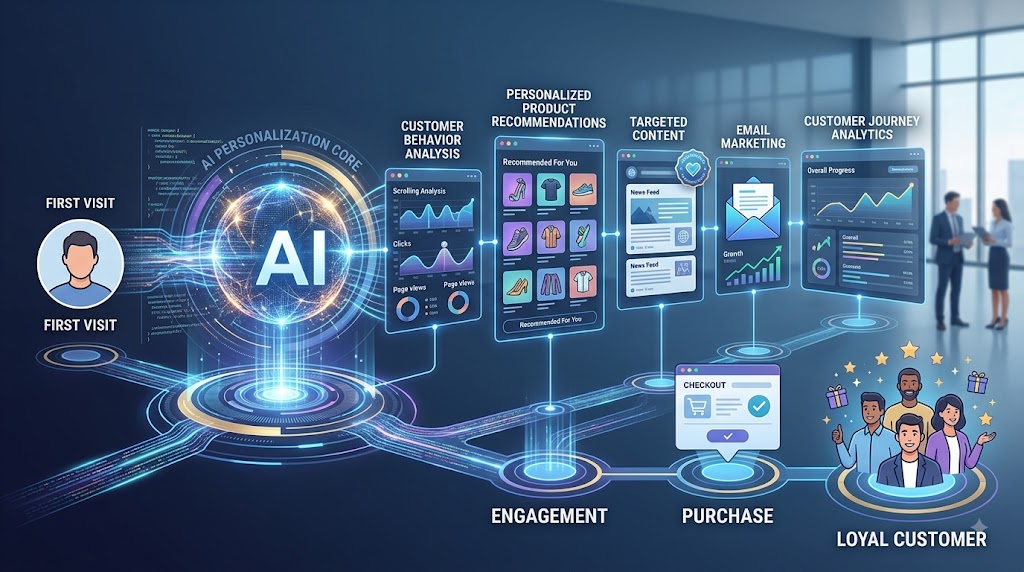
Getting a new visitor to a website is only the first step. The real challenge for brands is convincing that visitor to stay, explore products or services, make a purchase, and eventually return.
This is where AI personalization is changing modern marketing.
Traditional marketing often treats large groups of customers in a similar way. AI, however, can analyze browsing behavior, purchase history, search patterns, engagement, and other customer signals to help brands deliver experiences that feel more relevant to each individual.
Instead of showing every visitor the same product, email, advertisement, or content, brands can use artificial intelligence to understand what a customer may actually want.
The result can be a more relevant customer journey, stronger engagement, higher conversions, and better long-term customer retention.
What Is AI Personalization?
AI personalization refers to the use of artificial intelligence and machine learning to customize marketing messages, content, product recommendations, offers, and customer experiences based on individual behavior and preferences.
For example, imagine two people visit the same online clothing store.
One spends several minutes looking at running shoes, while the other explores formal shoes and office clothing. Showing both visitors exactly the same products would not necessarily create the best experience.
An AI-powered system can recognize these different interests and adjust recommendations accordingly.
The first visitor might see running shoes and sportswear, while the second receives recommendations for formal footwear and professional clothing.
This simple difference can make the shopping experience much more relevant.
How AI Turns Anonymous Visitors Into Potential Customers
One of the biggest advantages of AI personalization is its ability to analyze customer behavior even when someone has never purchased from a brand before.
AI systems can examine signals such as:
- Pages visited
- Products viewed
- Search queries
- Time spent on specific pages
- Click behavior
- Content engagement
- Referral source
- Previous interactions
- Device and browsing patterns
These signals can help marketers understand customer intent.
For instance, someone who repeatedly visits a product page, reads reviews, checks pricing, and compares features is probably closer to making a purchase than someone who simply visits the homepage.
AI can help identify these behavioral patterns and allow brands to respond with more relevant content or offers.
AI-Powered Product Recommendations
Product recommendations are one of the most visible applications of AI personalization.
Instead of manually deciding which products should appear together, AI algorithms can analyze patterns across thousands or millions of interactions.
A customer purchasing a laptop, for example, might receive recommendations for:
- Laptop accessories
- Wireless keyboards
- Protective cases
- Monitors
- USB hubs
- Software subscriptions
The recommendations become more useful when they are based on actual customer behavior rather than random promotions.
This approach can increase cross-selling opportunities while also helping customers discover products they genuinely need.
Personalized Content Creates Better Engagement
Personalization is not limited to e-commerce.
Brands can also use AI to personalize blog recommendations, landing pages, newsletters, videos, advertisements, and educational content.
Suppose a visitor regularly reads articles about digital marketing automation. Instead of promoting unrelated content, the brand can recommend additional resources around automation, analytics, AI tools, and customer acquisition.
This creates a natural content journey.
The customer does not have to search endlessly for relevant information because the brand is helping them find it.
AI Personalization in Email Marketing
Email remains an important marketing channel, but generic emails often struggle to capture attention.
AI can help brands determine:
- What content a customer is interested in
- Which products they are likely to purchase
- When they are most likely to engage
- Which customers may be losing interest
- What type of offer may encourage another purchase
For example, instead of sending the same promotional email to an entire customer database, a retailer could send different recommendations based on individual shopping behavior.
One customer may receive new sneaker recommendations, while another receives formal footwear offers.
This makes email communication feel less like mass advertising and more like a personalized conversation.
AI Helps Brands Understand Customer Intent
Customer intent is often hidden inside behavior.
A visitor may not explicitly say, “I am ready to buy.”
However, their actions can reveal valuable information.
Someone comparing prices, reading product reviews, checking shipping information, and returning to the same product multiple times may demonstrate strong purchase intent.
AI can identify these patterns much faster than manual analysis.
Marketers can then create different experiences for different stages of the customer journey.
Example:
Early-stage visitor:
Educational content and product guides.
Interested visitor:
Detailed comparisons and customer reviews.
High-intent visitor:
Product demonstrations, testimonials, or limited-time offers.
Existing customer:
Cross-sell recommendations and loyalty rewards.
This approach allows brands to communicate according to customer needs rather than simply pushing the same message to everyone.
AI Personalization and Customer Retention
Acquiring a new customer can be expensive. That makes retention particularly important for growing businesses.
AI personalization can support retention by continuously learning from customer behavior.
If a customer regularly buys from a brand, AI can help identify their preferences and recommend products or services that are relevant to them.
It can also detect changes in behavior.
For example, if a previously active customer suddenly stops opening emails or visiting the website, the brand may identify that customer as potentially disengaged.
A personalized re-engagement campaign could then offer helpful content, product recommendations, or a relevant incentive.
Practical Example: An Online Fashion Brand
Consider an online fashion company with thousands of customers.
Without personalization, every visitor may see similar promotions.
With AI personalization, the website can dynamically adapt.
A returning customer who frequently purchases sportswear could see:
- New athletic collections
- Running shoes
- Fitness accessories
- Sportswear discounts
Another customer interested in formal clothing could receive:
- Business shirts
- Formal shoes
- Blazers
- Office accessories
The website becomes more relevant without requiring marketers to manually create an individual experience for every customer.
Privacy Should Remain a Priority
AI personalization offers significant benefits, but brands should not ignore privacy.
Customers want relevant experiences, but they also expect transparency regarding how their data is collected and used.
Brands should focus on:
- Responsible data collection
- Clear privacy policies
- Appropriate consent mechanisms
- Strong data security
- Transparent personalization practices
- Avoiding excessive targeting
The goal should be to make customers feel understood not watched.
How Brands Can Start Using AI Personalization
Businesses do not need to transform their entire marketing strategy overnight.
They can begin with a few practical applications:
- Analyze website visitor behavior.
- Introduce AI-powered product recommendations.
- Personalize email campaigns.
- Segment customers based on behavior.
- Create personalized content journeys.
- Identify customers at risk of disengagement.
- Test different personalized offers.
- Measure conversions and retention rates.
The key is to start with a clear business objective rather than adopting AI simply because it is trending.
The Future of AI Personalization
As AI becomes more sophisticated, personalization is likely to move beyond simple product recommendations.
Brands will increasingly use AI to create complete customer journeys that adapt in real time.
A customer’s experience could change depending on their interests, previous interactions, current intent, and stage in the buying journey.
This means the future of personalization is not simply about showing customers their favorite products.
It is about understanding what they need next.
FAQs
What is AI personalization in marketing?
AI personalization uses artificial intelligence to analyze customer data and behavior and deliver more relevant content, recommendations, offers, and experiences.
How does AI personalization improve customer retention?
By providing more relevant experiences, recommendations, and communications, AI personalization can help customers feel more connected to a brand and encourage repeat engagement.
Is AI personalization only useful for e-commerce?
No. SaaS companies, media platforms, financial businesses, travel companies, agencies, and many other industries can use AI personalization.
Does AI personalization replace marketers?
No. AI can automate analysis and personalization, but marketers remain responsible for strategy, creativity, brand messaging, and ethical decision-making.
Conclusion
The days of treating every customer exactly the same are disappearing.
AI personalization allows brands to understand customer behavior, predict potential needs, and create experiences that are more relevant at every stage of the buying journey.
For first-time visitors, this can mean better recommendations and more useful content. For existing customers, it can create stronger engagement and encourage repeat purchases.
The brands that combine AI technology with genuine customer understanding will have a significant opportunity to build lasting relationships rather than simply chasing short-term conversions.